

Modernizing Broadcast at the U.S. Department of Health and Human Services
How CHESA designed, staged, and deployed a complete SMPTE ST 2110 broadcast infrastructure for one of the largest federal communications operations in Washington, D.C.
AT A GLANCE
| Category | Details |
|---|---|
| Client | U.S. Department of Health and Human Services (HHSTV) |
| Scope | Complete broadcast facility modernization: SDI to ST 2110 |
| Key Technologies | SMPTE ST 2110 / 2022-7, Cisco Nexus 9000, EVS Cerebrum, Imagine Communications Selenio Network Processor (SNP), Telestream, Riedel, Studio Technologies, TAG Video Systems, Christie, Vizrt |
| Production Spaces | Main Studio, Auditorium, Great Hall, Room 800 |
| Redundancy | End-to-end dual-path ST 2022-7 across all signal flows |
| Staging | 60% of system validated off-site before deployment |
THE SITUATION
The broadcast facility at HHS serves a public affairs mission that does not tolerate downtime. HHSTV produces live and recorded programming across multiple production spaces in the Hubert H. Humphrey Building, supporting everything from press briefings and executive communications to internal agency programming.
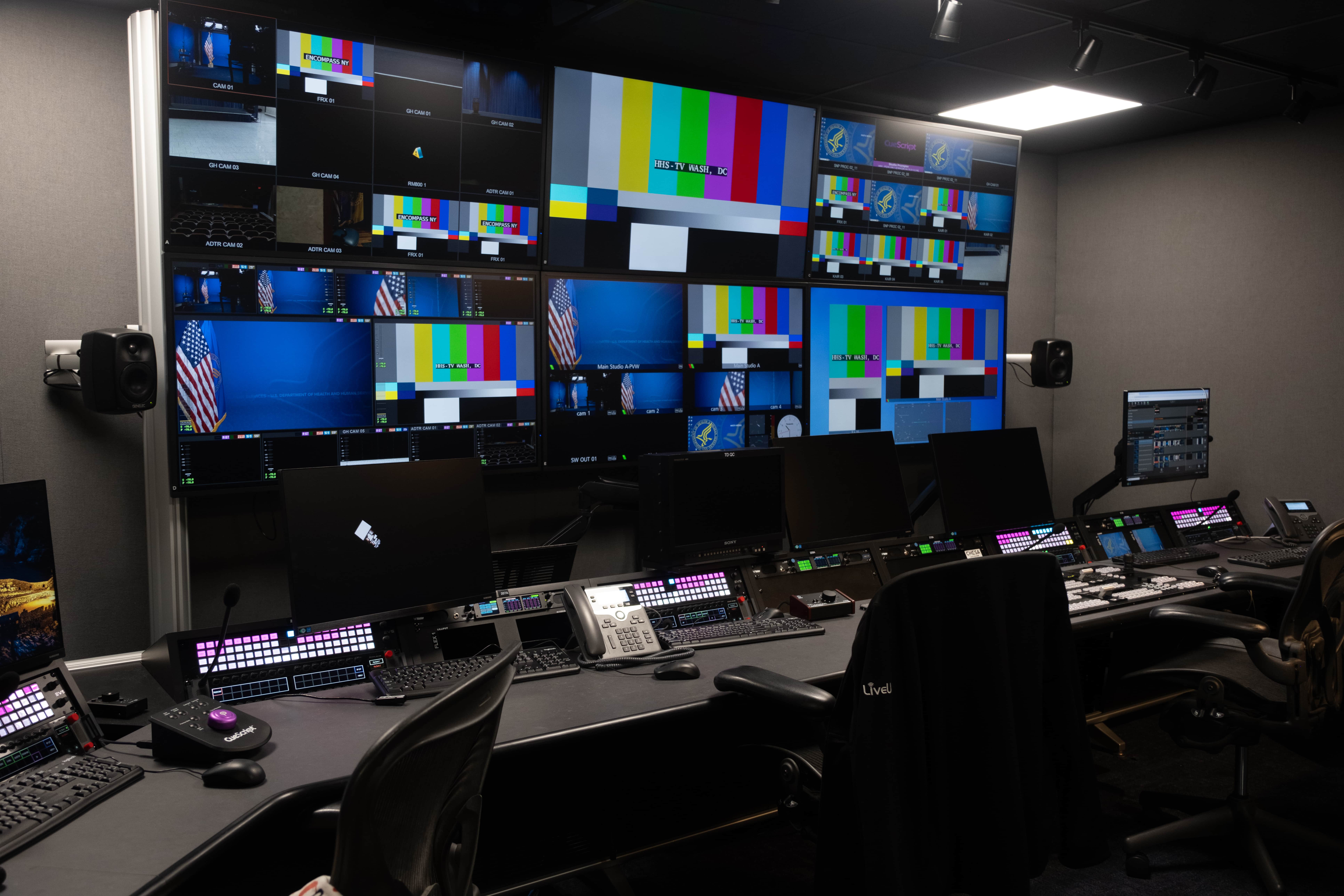
When the facility’s aging infrastructure began limiting what the production team could deliver, HHS leadership made the decision to modernize. The existing environment was built on a conventional SDI architecture centered on a Utah Scientific router at roughly 64×64. Signals traveled as home-run SDI paths terminating in the Central Equipment Room, with remote production areas connected via SDI-to-fiber extenders. The system operated in 1080i with limited 720p sources. No 3G-SDI. No progressive HD. No UHD capability anywhere in the chain.
Audio routing was handled ad hoc. Standalone converters from AJA and Blackmagic were inserted into signal paths for embedding and de-embedding as needed, creating fragmented signal chains with undocumented insertion points and increasing troubleshooting complexity during live production. Monitoring relied on a legacy SDI multiviewer and older waveform tools. Display infrastructure consisted of consumer-grade televisions mounted in grid arrangements.
The system had no redundancy of any kind. No alternate signal paths, no failover, no automated recovery. Any failure required manual intervention, often while a production was live.
THE APPROACH
CHESA was engaged as the sole systems integrator, responsible for architecture, design, procurement, staging, deployment, and commissioning. The mandate was clear: build it right, build it once.
The design had to meet four non-negotiable requirements: deterministic behavior under live production conditions, elimination of all single points of failure, consolidation of signal processing into core infrastructure platforms, and reduced dependency on engineering intervention for routine operations.
Those requirements drove the selection of SMPTE ST 2110 as the transport architecture, with ST 2022-7 seamless protection switching as a baseline across all signal flows. The entire media network was built on a Cisco Nexus 9000 spine-leaf topology implementing two fully independent fabrics that carry identical flows simultaneously. The SDI router was eliminated entirely and replaced with EVS Cerebrum as the orchestration layer, managing signal routing, device control, tally, and UMD coordination through NMOS discovery and connection management.
At the boundary between the legacy SDI toolchain and the new IP fabric, Imagine Communications Selenio Network Processor (SNP) handles all encapsulation and decapsulation. SNP is what makes the dual-fabric architecture work at the I/O layer: every SDI source is encapsulated into both 2022-7 legs simultaneously, and every SDI destination reconstructs its essence from whichever fabric path is healthy, with no operator action and no perceptible artifact during a path failure. SNP also provides the headroom that makes the rest of the system’s future-ready claims credible. The current operation is HD, but the edge processing layer is already capable of 12G-SDI and UHD, so format expansion will not require an edge hardware refresh.
A critical design decision was to stage approximately 60% of the system off-site before deployment. The full media fabric was constructed, configured, and tested in a controlled environment, covering network bring-up, switch configuration, PTP timing validation, NMOS registration, and initial endpoint commissioning. This approach substantially reduced on-site integration risk and compressed the deployment timeline.
HHS provided a temporary production capability during the transition period, enabling a hard cutover rather than a phased migration. On-site execution followed a structured sequence: rack deployment, network bring-up, system integration, and endpoint connection, followed by full production walkthroughs under live conditions.
KEY ENGINEERING CHALLENGES
Timing as Infrastructure
In an ST 2110 environment, timing is not a configuration detail. It is load-bearing infrastructure. Timing failures manifest as audio/video sync loss, frame discontinuities, and in severe cases, complete flow failure. The system uses a redundant pair of Telestream SPG9000 sync pulse generators as GNSS-locked PTP primary reference time clocks, with GPS antennas physically separated on the HHS rooftop to eliminate single-point timing failures. Boundary clock operation is distributed across every switch in the media path.
Encapsulating SDI Into a Dual-Fabric IP Network
In a facility where cameras, monitors, intercom panels, and ancillary devices still speak SDI, the edge of the IP fabric is where dual-path redundancy either holds together or quietly collapses. Every SDI source has to be encapsulated into ST 2110 essence and injected into both fabrics at the same time. Every SDI destination has to reconstruct video, audio, and ANC data from whichever fabric is healthy, with seamless ST 2022-7 hitless switching when the other one is not.
The facility uses Imagine Communications SNP as the edge gateway throughout. Each SNP performs SDI-to-IP encapsulation and decapsulation, frame synchronization, color and format conversion, and signal processing in a single device. From the network’s perspective, each SNP is a native ST 2110 endpoint, discovered and managed through NMOS IS-04 and IS-05 and routed via EVS Cerebrum.
Three architectural outcomes follow directly from this choice:
- Simultaneous dual-fabric injection. Sources are encapsulated into both 2022-7 legs concurrently. There is no active/standby behavior to manage at the edge.
- Native 12G-SDI and UHD headroom. The current operation is HD, but the edge processing layer is already capable of 12G and 4K. Format expansion is a configuration change, not a hardware swap.
- Stream count expansion without re-architecture. Additional channels are provisioned within the existing SNP footprint or by adding capacity to the same platform, without disrupting the topology.
This is the layer that makes phrases like ‘software-defined routing’ and ‘UHD-ready infrastructure’ actually mean something operationally. Without a deterministic, redundant, NMOS-managed edge, those phrases are marketing.
Bridging Dante and ST 2110 Audio
The audio system required bridging two fundamentally different timing domains. The production console is a Yamaha CL5 operating natively on Dante, which uses a 1 ms packet boundary. The ST 2110 fabric transports audio on ST 2110-30 at a 125 µs packet time. A Studio Technologies Model 5682 provides 64-channel bidirectional conversion, but resolving the timing alignment required direct analysis of the relevant SMPTE standards and iterative testing with the bridge vendor to validate behavior under production load. This is representative of a broader pattern in ST 2110 integration: domain boundaries concentrate integration risk, and vendor documentation alone is not a substitute for validation.
Vendor Interoperability in Practice
The system uses NMOS IS-04 and IS-05 for discovery and connection management. In principle, NMOS provides a vendor-neutral control surface. In practice, CHESA’s integration team encountered implementation-level differences across vendors, including inconsistencies in how frame rate information was represented in SDP descriptions. These issues are resolvable, but they underscore the importance of hands-on interoperability testing during equipment evaluation rather than relying solely on compliance declarations.
THE RESULTS
HHS now operates a fully modernized broadcast facility built for the next decade. The infrastructure supports current HD production with a clear architectural path to UHD. Format expansion and workflow changes can be achieved through configuration rather than physical infrastructure modifications.
| Capability | What It Means |
|---|---|
| Full ST 2022-7 Redundancy | Dual-path protection switching across every signal flow. No single points of failure. |
| Deterministic SDI/IP Edge | Imagine Communications SNP performs encap, decap, and processing at every SDI boundary with simultaneous dual-fabric injection and seamless protection switching. |
| Software-Defined Routing | Physical crosspoint switching replaced with network-based flow management via EVS Cerebrum and NMOS. |
| 12G and UHD-Ready Infrastructure | Native ST 2110 transport plus 12G-capable edge processing via Imagine Communications SNP. Format expansion through configuration, not construction. |
| Unified Wireless Intercom | Riedel Bolero coverage across four production spaces under a single coordinated system. |
| Three-Tier Monitoring | TAG multiviewer for operations, Telestream PRISM for T&M, Inspect 2110 for deep diagnostics. |
| Professional Display | Christie LED videowalls driven by Vizrt Multiplay replace consumer TV grids. |
The transition from consumer display grids to Christie LED videowalls driven by Vizrt Multiplay gives operators a configurable visual canvas rather than a fixed array of independent screens. Wireless intercom coverage via Riedel Bolero spans four discrete production spaces, enabling production coordination across the entire facility without reliance on fixed panels.
WHY IT WORKED
Stage first, integrate once. Off-site staging and pre-validation of the media fabric is the primary risk management mechanism on a project of this complexity. Building and testing 60% of the system before it ever reached the site compressed the deployment timeline and eliminated categories of integration risk entirely.
Treat timing and multicast like structural engineering. GNSS-locked redundant PTP, boundary clock distribution across the fabric, and rigorous IGMP and QoS policy are what make an ST 2110 system behave deterministically. These are design elements, not tuning tasks.
Design the edge for the architecture you want, not the one you have. Selecting Imagine Communications SNP at the SDI/IP boundary meant that simultaneous dual-fabric injection, NMOS-managed routing, and a clean path to 12G and UHD were architectural properties of the system, not retrofits. Edge gateway selection is one of the highest-leverage decisions on any 2110 facility build, because it determines what redundancy, scalability, and format expansion actually cost later.
Validate interoperability through integration, not spec sheets. Compliance declarations are a starting point. Real-world interoperability requires testing with specific attention to implementation-level details at domain boundaries.
Full accountability from architecture through commissioning. CHESA carried systems integration responsibility across every phase: design, procurement, staging, deployment, commissioning, and ongoing support. A single accountable integrator eliminates the gaps between disciplines that produce delays and finger-pointing on complex projects.
READY TO MODERNIZE YOUR FACILITY?
If your broadcast or production facility is running on aging SDI infrastructure, you are not alone. Many federal agencies, sports organizations, and enterprise media operations are facing the same decision HHS faced: continue patching legacy systems, or build a foundation designed for the next decade.
CHESA provides architecture assessment, detailed design, and complete deployment and commissioning services for broadcast facility modernization projects. We bring both the broadcast engineering expertise and the IP network engineering discipline that ST 2110 transitions require.